
How to Choose Broadband Billing Software
Download the Beyond the Demo White Paper
The document will be sent to the email address you provide.
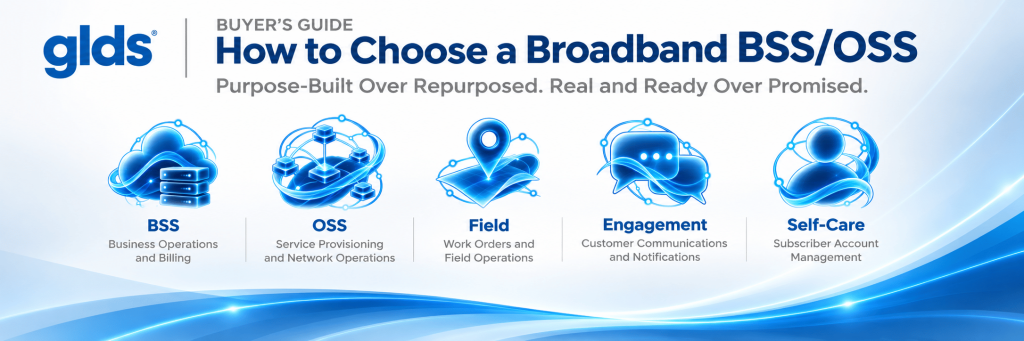
Purpose-Built Over Repurposed. Real and Ready Over Promised.
Choosing broadband billing software is one of the most consequential technology decisions a broadband service provider can make. The right platform does far more than generate invoices. It connects customer management, service provisioning, payments, field operations, and subscriber engagement into a reliable operational foundation.
But not all billing platforms are created for the same purpose.
Some were designed specifically for broadband service providers. Others began as utility billing systems, general-purpose CRMs, or enterprise platforms that were subsequently adapted to support broadband operations.
And even among broadband-focused platforms, there’s an important distinction between functionality that’s proven in production and functionality that exists primarily in demonstrations, development roadmaps, or marketing presentations.
Two questions should guide your evaluation: Was this software built for broadband? And is it ready to support your business today?
At GLDS, we believe the answers to both questions matter.
Why Purpose-Built Broadband Software Matters
Broadband isn’t simply another recurring billing business.
A broadband provider must manage a continuous relationship between the subscriber, the service, the network, and the bill. When a customer orders service, changes packages, replaces equipment, or disconnects, those activities often trigger processes across multiple operational systems.
A billing system designed for electricity, water, or another industry may be exceptionally capable within its original market. But adding broadband billing functionality doesn’t automatically make it a comprehensive broadband management platform.
The distinction becomes especially important as a provider grows.
Repurposed Systems Can Leave Operational Gaps
When broadband functionality is added to software originally designed for another purpose, providers should investigate how much of the broadband operational lifecycle is handled natively.
Does the system understand broadband-specific service packages, network provisioning, subscriber equipment, service activation, and changes to network-delivered services? Or must these capabilities be assembled through custom workflows, third-party applications, middleware, and manual processes?
Integrations can extend a platform’s functionality, but they shouldn’t become substitutes for essential broadband capabilities missing from the core system.
The concern isn’t necessarily that repurposed software cannot perform these functions. It’s that the provider may inherit responsibility for connecting, customizing, and maintaining capabilities that a purpose-built broadband platform already delivers.
Purpose-Built Means Broadband Is Fundamental, Not an Add-On
A purpose-built broadband Business Support System (BSS) and Operational Support System (OSS) are designed around the realities of delivering and managing broadband services.
Billing, provisioning, customer care, equipment, field operations, payment processing, and subscriber engagement are treated as interconnected elements of the business.
That foundation matters as operations become more complex. Adding subscribers shouldn’t require continually inventing workarounds or building new connections between systems that weren’t originally designed to work together.
Your broadband business shouldn’t have to adapt to the limitations of software built for another industry. Your software should be built around the needs of your broadband business.
Look Beyond the Demo. Choose What’s Real and Ready.
Modern interfaces matter. Artificial intelligence matters. APIs, automation, and configurable workflows matter.
But a polished demonstration doesn’t necessarily prove operational maturity.
Demos happen in controlled environments. Broadband operations don’t.
A demonstration might show how easily a new customer can be activated. A more revealing test is what happens when provisioning fails, an equipment change is interrupted, or a billing adjustment must synchronize across several systems.
Similarly, a vendor may demonstrate an impressive workflow builder or an extensive API library. But those capabilities don’t necessarily mean the workflows and integrations required to operate your business have already been developed, tested, and proven.
There is a fundamental difference between software that can be configured to support broadband operations and software that already supports those operations in production.
Don’t confuse what software can demonstrate with what it can reliably deliver.
Seven Things to Evaluate Before Choosing Broadband Billing Software
1. Purpose-Built Broadband Functionality
Start by understanding the platform’s origins.
Was it designed for broadband service providers, or was it adapted from utility billing, enterprise accounting, or another industry?
Evaluate how the software handles recurring billing, prorations, service packages, taxation, payment processing, collections, subscriber equipment, and service provisioning.
More importantly, determine whether these functions operate as part of a unified broadband management platform or depend on custom development and loosely connected applications.
Ask the vendor:
Was your platform originally designed for broadband service providers?
Which broadband-specific capabilities are native to the software?
What additional applications or customizations are required?
Can you demonstrate billing, provisioning, and subscriber management operating together?
What matters: Broadband functionality should be foundational to the system, not something assembled after the fact.
2. End-to-End BSS/OSS Integration
Billing is only one component of broadband operations.
When subscribers order service, upgrade packages, replace equipment, or disconnect, billing and network provisioning must remain synchronized.
A broadband platform should support the full subscriber lifecycle, connecting customer records, service packages, network provisioning, equipment management, payments, and customer communications.
When these functions are disconnected, the consequences can include billing discrepancies, provisioning errors, revenue leakage, and unnecessary customer service activity.
Ask the vendor:
How does the platform keep billing and provisioning synchronized?
What happens when a service activation or equipment change fails?
Can customer service representatives see the relevant service and equipment information in one place?
How are discrepancies identified and resolved?
What matters: The services customers receive should match the services they’re billed for, without relying on manual reconciliation.
3. Proven Integrations, Not Just Available APIs
Modern broadband providers depend on interconnected technology ecosystems.
Network provisioning systems, payment processors, taxation engines, customer portals, voice platforms, GIS systems, field-service applications, and customer experience tools must work together reliably.
Open APIs and webhooks are valuable, but they represent the potential to integrate. They don’t necessarily establish that an integration already exists or has been proven in production.
An integration isn’t operationally mature simply because two systems can exchange data. It must also handle exceptions, maintain synchronization, and adapt as connected technologies change.
Ask the vendor:
Which integrations are already deployed in production?
Which require new development or third-party middleware?
Who maintains the integrations when connected systems change?
How are integration errors monitored, reported, and resolved?
What matters: There’s a significant difference between enabling integrations and operationalizing them.
4. Automation That Works Under Pressure
Automation is one of the most heavily promoted capabilities in broadband software.
Providers should expect automation to reduce manual work involving service activations, disconnects, equipment changes, upgrades, billing events, customer notifications, and operational escalations.
But the existence of a workflow builder doesn’t guarantee dependable automation.
In some platforms, providers become responsible for designing, testing, maintaining, and troubleshooting the workflows themselves. What initially appears flexible can become a substantial operational responsibility.
Ask the vendor:
Which automated processes are available and proven today?
What happens when an automated process encounters an exception?
Who maintains the underlying workflows and operational rules?
Can you provide examples of automation operating at scale?
What matters: Automation should reduce operational complexity, not transfer responsibility for maintaining software logic to the broadband provider.
5. Scalability and Operational Experience
A platform that works well for 1,000 subscribers may face entirely different challenges at 10,000 or 100,000.
As networks grow, provisioning volumes increase, integrations become more demanding, reporting requirements expand, and operational exceptions multiply.
These challenges can expose what GLDS describes as the Fiber Gap: the growing distance between what a provider’s existing operational systems can support and what its expanding broadband business requires.
Experience across different types of broadband providers also matters.
Electric cooperatives, municipalities, private fiber operators, cable companies, and other service providers operate with different business models, network technologies, billing requirements, and customer expectations.
A platform developed around one operator’s experience may not have been proven across that broader range of operational environments.
Ask the vendor:
How many broadband providers use your platform in production?
How many subscribers do your largest customers support?
Can you provide references from providers similar to ours?
How has the platform performed as customers have grown?
What matters: Scalability and maturity should be demonstrated through production experience, not assumed from architecture or marketing claims.
6. Migration Experience and Business Continuity
Replacing broadband billing software is far more complicated than moving customer records from one database to another.
A successful migration must preserve the relationships between subscriber accounts, service packages, network equipment, provisioning status, taxation, payments, and reporting.
Every dependency matters because the provider must continue delivering services while the underlying business systems change.
Migration integrity is therefore one of the clearest demonstrations of operational maturity.
Ask the vendor:
How many broadband migrations have you completed?
How do you validate customer, service, and billing data before conversion?
What processes minimize disruption to subscribers and customer service teams?
What happens if something goes wrong during migration?
What matters: Migrating data is relatively straightforward. Preserving a live broadband business is the real challenge.
7. Total Cost of Ownership and Long-Term Partnership
Software licensing is only one component of the overall investment.
Implementation, integrations, hosting, customization, support, upgrades, training, and internal staffing can all materially affect the long-term cost of a billing platform.
This is especially important when evaluating repurposed systems or highly configurable platforms that require substantial customization to support broadband operations.
Providers should understand not only what the software costs to purchase, but what it will cost to maintain and operate as the business grows.
Ask the vendor:
Which capabilities are included in the standard platform?
What requires additional licensing, implementation, or development?
How much internal technical expertise will we need?
Who is responsible for ongoing integration and workflow maintenance?
What will this platform cost to operate five years from now?
What matters: The least expensive software to purchase isn’t necessarily the least expensive platform to own.
Operational Maturity Isn’t a Promise. It’s a Track Record.
The most demanding aspects of broadband operations rarely appear during a software demonstration.
They emerge when subscriber counts accelerate, integrations change, provisioning exceptions increase, automation must perform under pressure, and the business depends on multiple systems remaining synchronized.
A platform’s ability to manage those conditions is developed through years of experience solving real operational problems.
That experience can’t be replaced by an impressive user interface, an ambitious development roadmap, or the promise that nearly anything can be built.
The question isn’t whether a vendor believes its software can support your business. It’s whether the vendor can demonstrate that it already does.
GLDS: Purpose-Built. Real and Ready.
For more than four decades, GLDS has focused on developing software specifically for the broadband industry.
Our BroadHub® platform brings together broadband billing, customer management, service provisioning, automation, and operational capabilities. Rather than adapting technology designed for another industry, GLDS solutions have evolved through decades of supporting the real-world needs of broadband providers.
Our experience spans electric cooperatives, municipalities, private fiber operators, cable providers, and other broadband businesses, each with different operating requirements and technology environments.
And that experience is measurable.
Proven Broadband Experience
875+ Deployments
GLDS software has supported more than 875 broadband deployments across a wide range of provider types, business models, and operating environments.
80+ Integration Partners
GLDS maintains an extensive ecosystem of broadband technology integrations, connecting business operations with network systems, payment platforms, customer experience tools, and other essential technologies.
17,000+ Automated Work Orders
Over 12 months, MidSouth Fiber processed more than 17,000 equipment-impacting work orders using GLDS automation, avoiding an estimated 8,500 hours of manual labor.
100,000+ Subscribers Migrated
During the Conexon transformation initiative, more than 100,000 subscribers were migrated into an integrated GLDS and Calix environment, with zero service disruption and improved data fidelity.
These aren’t demonstrations of what might someday be possible.
They’re examples of what’s already working.
Choose Software Built for Broadband. Proven in Broadband.
Your broadband billing software should do more than calculate recurring charges. It should provide the operational foundation for managing subscribers, services, network provisioning, payments, equipment, and customer engagement as your business grows.
That starts with choosing technology designed specifically for broadband, rather than adapting software built for an entirely different industry.
But purpose-built architecture is only the beginning. Providers also need evidence of real-world performance: established integrations, dependable automation, successful migrations, and years of experience supporting actual broadband operations.
At GLDS, we believe broadband providers deserve more than a compelling presentation and a promising roadmap.
Purpose-Built Over Repurposed. Real and Ready Over Promised.
Because choosing broadband software shouldn’t be about what a platform might become.
It should be about what your business can depend on today.
Explore GLDS Integrations
Read Our Customer Reviews
Purpose-Built for Broadband. Not Repurposed for It.
A truly integrated BSS/OSS requires more than connecting two software products.
Utility billing systems, generic CRMs, and repurposed enterprise platforms may offer broadband functionality, but supporting the complete subscriber lifecycle often requires extensive customization, additional applications, and integration development.
GLDS takes a different approach.
BroadHub was built specifically for broadband operations. Customer management, billing, service definitions, equipment tracking, work orders, and related operational capabilities are part of its native foundation. BroadHub LINK extends that foundation to the network through proven provisioning integrations.
Sales, customer engagement, field operations, and self-care extend the same ecosystem rather than introducing isolated applications that must constantly reconcile information.
The distinction is important: broadband functionality is not the same as broadband depth.
A platform should do more than demonstrate that individual features exist. It should show how those features operate together in a live broadband environment, across the complete subscriber lifecycle.
GLDS has spent more than four decades building, testing, and refining those operational relationships.
Proven Integrations. Real Operational Depth.
No broadband provider operates in a completely closed technology environment.
Access networks, voice platforms, managed Wi-Fi, payment processors, tax services, and customer experience technologies all play important roles in delivering broadband service.
GLDS has established relationships with more than 80 industry solution providers, supporting integrations across the technologies broadband operators depend on.
Our approach goes beyond simply providing access to an API. GLDS focuses on the operational details required to make integrations work reliably, including data mapping, sequencing, service changes, exception handling, testing, and deployment.
The objective is straightforward: Allow broadband providers to select the technologies that best serve their business without sacrificing the operational advantages of an integrated BSS/OSS.
One Platform. Multiple Ways to Deploy.
Broadband providers have different infrastructure, operational, and business requirements.
GLDS supports both cloud-hosted and on-premises deployment, giving operators flexibility in how they manage their BSS/OSS environment.
Whether supporting a new fiber network, a growing municipal or electric cooperative broadband operation, or an established multi-service provider, the GLDS platform can accommodate different business models and stages of growth.
And because BroadHub LINK can also operate with third-party BSS platforms, providers can take advantage of GLDS’ provisioning and integration expertise without necessarily replacing their existing billing system.
Real & Ready. Not Just Promised.
Broadband providers should expect more than an impressive demonstration or an ambitious product roadmap.
They should expect operationally mature software, proven integrations, and workflows that have already been tested in real broadband businesses.
With more than 875 deployments worldwide, GLDS brings decades of practical broadband experience to the systems providers depend on every day.
From capturing a new subscriber to activating service, managing the customer relationship, billing accurately, and collecting payment, GLDS connects the activities that make a broadband business work.
Complete BSS/OSS.
Purpose-built for broadband.
Proven in the real world.
See the Complete GLDS BSS/OSS Platform in Action
Discover how GLDS can connect your sales, customer management, billing, provisioning, field operations, and customer engagement in one integrated broadband management environment.
No Drama. Proven Integrations. Simply Works.