
Broadband BSS/OSS Built for Fiber
Download the "Built for Broadband" Position Paper
The document will be sent to the email address you provide.
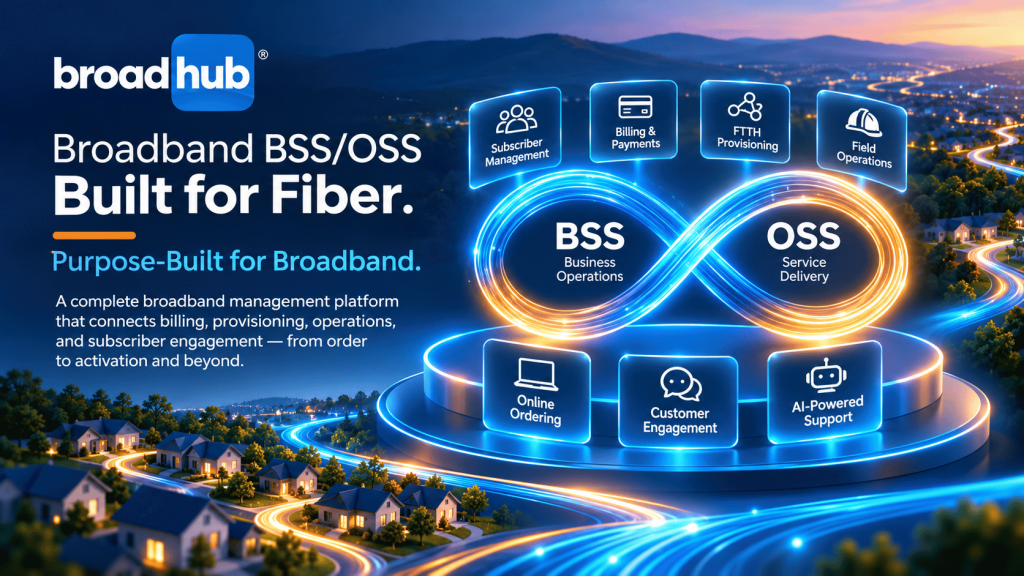
Broadband BSS/OSS Built for Fiber.
Purpose-Built for Broadband.
Complete broadband management software for billing, provisioning, customer care, field operations, and subscriber engagement.
Fiber broadband is a different business, and it demands a different kind of management system.
GLDS® delivers integrated Business Support Systems (BSS) and Operations Support Systems (OSS) designed specifically for broadband service providers. From the first customer inquiry through ordering, installation, provisioning, billing, support, and retention, our solutions connect the people, processes, and technologies that keep broadband businesses running.
Whether you’re launching a new fiber-to-the-home (FTTH) network, expanding an established ISP, or replacing a legacy billing platform, GLDS provides the operational foundation to compete, scale, and serve subscribers effectively.
Not adapted from another industry. Not built around theoretical workflows. Purpose-built for broadband.
What Is BSS/OSS in Broadband?
BSS/OSS refers to the business and operational software used to manage a telecommunications or broadband service provider.
BSS (Business Support Systems) manages the commercial side of the subscriber relationship, including customer accounts, CRM, product offerings, order management, billing, payments, collections, and customer service.
OSS (Operations Support Systems) manages the operational processes required to deliver service, including network and equipment provisioning, service activation, changes and disconnects, and integration with network management platforms.
For fiber-to-the-home (FTTH) and other broadband networks, these two disciplines must work together.
When a subscriber orders a new fiber service, the BSS manages the account, package, pricing, and order. The OSS helps coordinate the network changes required to deliver that service. As the subscriber upgrades, changes equipment, makes payments, or disconnects, the systems must remain synchronized.
A modern broadband management system extends beyond traditional BSS and OSS to include workforce management, digital self-service, proactive communications, analytics, and AI-powered customer engagement.
The objective is simple: what the subscriber orders, what the provider bills, and what the network delivers should always match.
Explore GLDS Business Support Systems and Operations Support Systems.
Why Fiber Broadband Requires Purpose-Built BSS/OSS Software
Fiber networks introduce operational requirements that general-purpose billing software and repurposed management systems may not adequately support.
FTTH providers must coordinate network serviceability, customer acquisition, equipment assignments, installation scheduling, ONT activation, service provisioning, speed changes, recurring billing, customer communications, and technical support.
These are not independent activities. They are interconnected broadband workflows.
A billing system originally designed for another industry may support subscriber accounts and recurring charges but lack the operational depth needed to manage fiber service delivery. Similarly, a platform with modern interfaces and configurable workflows may still require significant custom development to perform routine broadband operations.
Broadband functionality is not the same as broadband depth.
Purpose-built broadband BSS/OSS software understands the entire subscriber lifecycle, including the relationships between service packages, network equipment, field activities, billing events, and customer experience.
GLDS was built around these requirements. Broadband is not a module or secondary market within our platform. It is our business.
One Broadband Management Platform. The Complete Subscriber Lifecycle.
The best broadband management systems do more than automate billing. They connect commercial activity, service delivery, and subscriber engagement into a coordinated operational environment.
Broadband BSS: Billing, CRM, and Subscriber Management
BroadHub® is GLDS’ comprehensive broadband Business Support System, combining subscriber account management, billing, service packages, payments, and operational workflows.
BroadHub supports the business models fiber ISPs and other broadband providers actually use, including residential and business services, speed tiers, bundled offerings, managed Wi-Fi, equipment charges, promotional pricing, prepaid and postpaid billing, and recurring service plans.
Customer activity is connected to the larger operating environment, allowing service changes, payments, work orders, and account events to drive downstream processes.
Explore Broadband BSS and Billing
Broadband OSS: Automated FTTH and Network Provisioning
Fiber providers cannot afford to manage service activations, speed changes, and disconnects through manual data entry or disconnected systems.
GLDS BroadHub Link™ provides the operational integration between subscriber management and the network systems responsible for delivering broadband service.
Through established integrations with major broadband technology providers, GLDS supports automated service activation, upgrades, downgrades, suspensions, reconnections, and disconnects.
The result is faster service delivery, fewer manual processes, and improved consistency between billing and provisioning.
Explore Broadband OSS and Provisioning
Online Ordering and Digital Subscriber Acquisition
Modern fiber providers need more than a website that collects prospective customer information.
Subscribers should be able to check service availability, review eligible packages, select services, submit orders, and schedule installation online.
GLDS connects digital ordering with the underlying broadband management platform, reducing manual handoffs between sales, customer service, scheduling, and provisioning.
The goal is to move customers efficiently from interest to installation without requiring staff to reconstruct an order already entered online.
Subscriber Self-Care and Account Management
Today’s broadband subscribers expect convenient access to their accounts without contacting a call center for every routine request.
GLDS self-care capabilities support online account management, bill viewing, payments, autopay, and service changes.
Subscribers can manage their broadband relationship digitally, while account activity remains connected to the systems used by customer service and billing teams.
Work Orders and Field Service Management
Broadband work orders are more than task records. They represent operational changes that can affect subscribers, equipment, provisioning, appointments, and billing.
GLDS includes native work order and field service management capabilities that connect dispatchers, technicians, subscriber accounts, equipment, and service activity.
Mobile field tools give technicians access to customer information, service details, equipment records, work orders, and documentation while on site.
Field activity can update the operational system directly, reducing unnecessary communication with dispatch and the need for subsequent administrative reconciliation.
Explore Work Order and Field Management
Automated Customer Communication
Proactive communication is no longer a premium feature. It is a basic expectation of modern broadband service.
GLDS supports automated email and SMS communications connected to real operational events, including payments, appointments, service changes, work orders, and account activity.
With more than 75 automated communication triggers and support for two-way text messaging, providers can keep subscribers informed without relying on repetitive manual outreach.
AI-Powered Broadband Customer Engagement
Artificial intelligence is creating new opportunities to improve customer service, but useful broadband AI must do more than answer frequently asked questions.
HubTalk™ is GLDS’ AI-powered customer engagement solution, designed with native access to BroadHub and connected operational systems.
Unlike a generic chatbot, HubTalk is designed to use subscriber context to help with account inquiries, payment assistance, service changes, outage information, and other routine support activities.
By handling repetitive interactions, HubTalk allows customer service representatives to spend more time resolving complex problems, supporting subscribers, and managing conversations that require human judgment.
GLDS is also developing additional AI capabilities involving predictive data migration, data quality, and intelligent integration.
Open, Proven Integrations for the Fiber Ecosystem
A broadband management platform is only as effective as its ability to operate within the provider’s technology environment.
Fiber ISPs depend on access networks, customer experience platforms, voice systems, payment processors, taxation services, GIS systems, analytics, and other specialized technologies.
GLDS supports integrations with more than 80 broadband ecosystem partners, including technologies from Calix, Adtran, Nokia, Alianza, and other established providers.
These integrations connect operational processes across the broadband business, reducing dependence on duplicate entry and fragile manual procedures.
Explore GLDS Integrations, and our Integration Partners
RESTful APIs, webhooks, and emerging Model Context Protocol (MCP) capabilities are important components of that strategy.
RESTful APIs support structured communication between systems. Webhooks allow operational events to trigger downstream activity. GLDS is developing an AI-enabled MCP layer intended to make proven interfaces easier to extend and connect with emerging AI applications.
But access to an API alone does not make an integration production-ready.
The real differentiator is the experience required to design, validate, maintain, and operate those integrations reliably as subscriber counts and operational complexity grow.
What Makes the Best Broadband BSS/OSS Systems Different?
Organizations searching for the best broadband management software, comparing the top BSS/OSS systems, or evaluating fiber ISP billing platforms should look beyond feature lists and demonstrations.
The strongest platforms combine the following capabilities:
Purpose-built broadband architecture. Broadband is central to the platform’s design, workflows, and product roadmap.
Complete BSS/OSS integration. Billing, subscriber management, provisioning, and service delivery operate in coordination.
Real-time provisioning. Orders, upgrades, suspensions, and disconnects flow automatically into network service delivery.
Flexible broadband product management. Speed tiers, bundles, promotions, equipment charges, and service offerings can evolve with market requirements.
Digital customer acquisition and self-care. Subscribers can order, pay, schedule, manage, and change services online.
Native field and work order management. Technicians and dispatchers operate with real-time subscriber, equipment, and service information.
Automated, two-way customer communication. Messaging is connected to actual account and service events.
Open and proven integrations. APIs, webhooks, and established partner integrations connect the broader broadband ecosystem.
Practical AI capabilities. Intelligent tools have access to the operational context required to provide meaningful assistance.
Demonstrated production maturity. The vendor has successfully supported broadband deployments, migrations, integrations, and automation in real operating environments.
These criteria provide a more useful basis for evaluating the leading BSS/OSS software platforms than the number of capabilities appearing on a sales presentation.
A platform should not merely demonstrate that a workflow can be built. It should demonstrate that the workflow already operates reliably under real broadband conditions.
Read: Best Broadband Billing Software – What to Look For
Purpose-Built vs. Repurposed Broadband Management Systems
Not every system marketed as broadband management software was originally designed to operate a broadband business.
Some platforms began as utility billing systems, enterprise resource planning applications, or generalized customer management solutions. Others originated as internal tools supporting a single service provider before being commercialized.
These systems may offer valuable functionality, but buyers should evaluate whether their architecture, workflows, and product roadmap reflect the full range of broadband operational requirements.
A purpose-built broadband management system must account for more than customer records and monthly invoices. It must coordinate competitive offers, service qualification, installation, equipment, network activation, customer communications, billing, field operations, support, and retention.
GLDS brings more than four decades of experience supporting different broadband operating models. That experience is reflected in the platform’s established workflows and extensive integration ecosystem.
Purpose-built is not simply a description of how a platform started. It is a measure of how completely that platform supports broadband operations today.
Proven at Scale. Real and Ready.
A successful demonstration does not establish whether a broadband management system can support a growing subscriber base.
As providers scale, exceptions increase, integrations become more complex, and operational consistency becomes more important.
GLDS has supported more than 875 broadband deployments worldwide, across a wide range of operating environments and business models.
That experience includes greenfield fiber launches, established provider operations, complex migrations, multi-system integrations, and large-scale automation.
For example, MidSouth Fiber processed more than 17,000 equipment-impacting work orders over 12 months using GLDS automation. The resulting automation addressed work that otherwise would have required thousands of hours of manual intervention.
In a separate transformation involving Conexon, more than 100,000 subscribers were migrated into an integrated GLDS and Calix environment, with no service disruption and measurable improvements in data fidelity.
These examples demonstrate why broadband providers should evaluate operational maturity, not simply software architecture or marketing claims.
Real systems. Proven integrations. Production-ready broadband operations.
Fiber BSS/OSS Software for Every Stage of Growth
Broadband providers have different operating requirements, but the need for connected, dependable systems is consistent.
GLDS supports:
Fiber-to-the-home (FTTH) providers launching, operating, and expanding fiber networks.
Independent ISPs and private fiber operators competing through differentiated packages and subscriber experience.
Municipal broadband providers building community networks with modern broadband-specific operations.
Electric cooperatives expanding into fiber while maintaining the operational capabilities needed to compete as broadband providers.
Cable and multi-service operators managing broadband, voice, and video services within integrated business workflows.
Regional telecom providers modernizing legacy subscriber management and provisioning environments.
Fixed wireless and hybrid network operators supporting multiple access technologies and service models.
GLDS offers both cloud-hosted and on-premises deployment options, allowing providers to select an operating model appropriate for their technical and business requirements.
Frequently Asked Questions About Broadband BSS/OSS
What is the difference between BSS and OSS?
BSS manages the business relationship with subscribers, including CRM, orders, billing, payments, and customer support. OSS manages the operational processes required to deliver services, including provisioning, equipment control, and network integrations. An integrated BSS/OSS platform connects these functions so subscriber activity and network service delivery remain synchronized.
What is the best BSS/OSS software for fiber providers?
The best fiber BSS/OSS software depends on the provider’s size, network technology, operational requirements, and growth plans. Buyers should prioritize purpose-built broadband functionality, automated FTTH provisioning, billing and CRM integration, proven network interfaces, self-service capabilities, and established production experience. GLDS is a purpose-built broadband BSS/OSS provider with more than 40 years of industry experience.
What is FTTH management software?
FTTH management software supports the business and operational requirements of fiber-to-the-home service providers. This includes subscriber acquisition, serviceability, installation scheduling, ONT provisioning, package management, billing, equipment tracking, customer support, and service changes.
Can one broadband management system handle billing and provisioning?
Yes. An integrated broadband BSS/OSS platform can connect subscriber accounts, service packages, billing, and network provisioning through coordinated workflows. GLDS combines BroadHub for business operations with BroadHub Link for network and service delivery integrations.
How should I compare the top BSS/OSS systems?
Compare platforms based on broadband-specific functionality, provisioning maturity, integration quality, operational automation, product flexibility, self-service capabilities, implementation experience, and demonstrated performance at scale. Request demonstrations of actual subscriber workflows and ask for production references rather than relying exclusively on feature checklists.
Can BSS/OSS software integrate with Calix, Adtran, Nokia, and other fiber networks? Can it support all of them at the same time?
Yes. BSS/OSS platforms can integrate with supported interfaces from major fiber network technology providers – and it can manage a mixed vendor environment seamlessly. GLDS maintains established integrations across a broad broadband ecosystem, including Calix, Adtran, Nokia, and many others. Specific functionality depends on the network platform and integration.
Is purpose-built broadband software better than repurposed billing software?
Purpose-built broadband software is designed around service provider workflows, including ordering, installation, provisioning, equipment, billing, and customer engagement. Repurposed software may support some of these functions but may require additional development or integrations. Buyers should evaluate demonstrated operational depth rather than relying on a vendor’s feature list.
Does modern broadband BSS/OSS include AI and automation?
Modern broadband management systems increasingly incorporate automated provisioning, event-driven communication, AI-assisted customer engagement, and intelligent integrations. GLDS provides established broadband automation and is expanding AI capabilities through HubTalk, predictive data quality initiatives, and emerging MCP-based integration technologies.
Choose a Broadband Management System Built for Your Business
The right BSS/OSS platform should do more than manage subscribers and generate invoices.
It should help you launch services faster, reduce manual work, connect network operations, improve customer experiences, and scale without creating unnecessary operational complexity.
GLDS delivers purpose-built broadband management software with the integrated capabilities, proven integrations, and industry experience required to support real-world fiber operations.
Broadband is our focus. Operational depth is our advantage. Real and Ready.
Purpose-Built for Broadband. Not Repurposed for It.
A truly integrated BSS/OSS requires more than connecting two software products.
Utility billing systems, generic CRMs, and repurposed enterprise platforms may offer broadband functionality, but supporting the complete subscriber lifecycle often requires extensive customization, additional applications, and integration development.
GLDS takes a different approach.
BroadHub was built specifically for broadband operations. Customer management, billing, service definitions, equipment tracking, work orders, and related operational capabilities are part of its native foundation. BroadHub LINK extends that foundation to the network through proven provisioning integrations.
Sales, customer engagement, field operations, and self-care extend the same ecosystem rather than introducing isolated applications that must constantly reconcile information.
The distinction is important: broadband functionality is not the same as broadband depth.
A platform should do more than demonstrate that individual features exist. It should show how those features operate together in a live broadband environment, across the complete subscriber lifecycle.
GLDS has spent more than four decades building, testing, and refining those operational relationships.
Proven Integrations. Real Operational Depth.
No broadband provider operates in a completely closed technology environment.
Access networks, voice platforms, managed Wi-Fi, payment processors, tax services, and customer experience technologies all play important roles in delivering broadband service.
GLDS has established relationships with more than 80 industry solution providers, supporting integrations across the technologies broadband operators depend on.
Our approach goes beyond simply providing access to an API. GLDS focuses on the operational details required to make integrations work reliably, including data mapping, sequencing, service changes, exception handling, testing, and deployment.
The objective is straightforward: Allow broadband providers to select the technologies that best serve their business without sacrificing the operational advantages of an integrated BSS/OSS.
One Platform. Multiple Ways to Deploy.
Broadband providers have different infrastructure, operational, and business requirements.
GLDS supports both cloud-hosted and on-premises deployment, giving operators flexibility in how they manage their BSS/OSS environment.
Whether supporting a new fiber network, a growing municipal or electric cooperative broadband operation, or an established multi-service provider, the GLDS platform can accommodate different business models and stages of growth.
And because BroadHub LINK can also operate with third-party BSS platforms, providers can take advantage of GLDS’ provisioning and integration expertise without necessarily replacing their existing billing system.
Real & Ready. Not Just Promised.
Broadband providers should expect more than an impressive demonstration or an ambitious product roadmap.
They should expect operationally mature software, proven integrations, and workflows that have already been tested in real broadband businesses.
With more than 875 deployments worldwide, GLDS brings decades of practical broadband experience to the systems providers depend on every day.
From capturing a new subscriber to activating service, managing the customer relationship, billing accurately, and collecting payment, GLDS connects the activities that make a broadband business work.
Complete BSS/OSS.
Purpose-built for broadband.
Proven in the real world.
See the Complete GLDS BSS/OSS Platform in Action
Discover how GLDS can connect your sales, customer management, billing, provisioning, field operations, and customer engagement in one integrated broadband management environment.
No Drama. Proven Integrations. Simply Works.