One Platform, Every Part of the Subscriber Experience
Calix One brings Calix’s full portfolio together on a single, unified platform: access and subscriber appliances, cloud software, AI agents, and managed services. Marketing works from real network insight. Support sees the home network as the subscriber does. Operations sees ONT health before a truck rolls. AI agents take on work across all three. And managed services like ProtectIQ, ExperienceIQ, and SmartBiz give providers new revenue on top of the connection.
It is a complete ecosystem. The question for a provider isn’t whether Calix can do it. It is whether their back office can keep up with everything Calix can do.
What “Automation” Usually Means
Most broadband providers launch with whatever their BSS/OSS vendor calls automation. On day one, the differences are hard to see. A subscriber gets activated, a bill goes out, and the integration box is checked.
Look closer, and integrations vary widely. Some vendors exchange flat files on a schedule, so the network learns about a change hours later. Others built a basic connection years ago and haven’t touched it since, while Calix kept adding clouds, services, and devices.
Both approaches can turn up a subscriber. Neither keeps pace with the platform. And the gap between what Calix offers and what the back office actually uses grows every year.
The Sync Gap
We call that distance the Sync Gap: the space between what billing says a subscriber has and what the network delivers.
The Sync Gap is not a network problem. The network does exactly what it is told. It is an integration problem: the BSS/OSS isn’t telling the network everything, or isn’t telling it fast enough. It shows up as friction teams learn to live with:
- Activations wait for someone to finish provisioning by hand
- Managed services are sold but not turned on, or turned on but not billed
- Equipment swaps leave stale ONT or RG records in billing
- Marketing campaigns run on subscriber data that is days old
- Support agents re-key or cross-check information between systems
- Licensed Calix capabilities sit underused because the back office can’t feed them
That last one stings most. Providers invest in a platform built to do it all, then use a fraction of it.
Growth Changes the Math
Every new install, upgrade, downgrade, and equipment swap is a work order that touches the network. One fiber provider running Calix with BroadHub processed 17,018 equipment-affecting work orders in a single year. Done by hand, at 30 minutes each, that would have been 8,509 hours of labor. At $23 an hour, it comes to $195,707 a year spent keying the same change into a second system.
The labor is only the visible part. Every manual step is a chance to provision the wrong package, miss an add-on, or leave a service running after it was cancelled. Subscribers notice when they don’t get what they pay for. Finance notices, eventually, when they get what they don’t pay for.
Full automation removes both costs. Each subscriber gets the exact services they subscribe to, no more and no less, and the team spends its time on subscribers instead of keystrokes.
GLDS Does It All for Calix
GLDS integrates with leading fiber access vendors across the industry. With Calix, we go all the way. No one integrates more comprehensively across the entire Calix ecosystem than GLDS BroadHub®.
BroadHub connects through the Calix Cloud API and the Calix Subscriber Services API. BroadHub is the system of record for billing, and every change made there reaches Calix automatically. Follow one change through:
- Record. A CSR adds a subscriber, changes a package, or swaps an ONT or RG in BroadHub. That is the only place the change is entered.
- Feed. The Calix Cloud API sends the updated subscriber and device data to Calix Cloud in real time.
- Provision. SuperController activates the access layer in Calix SMx, for one-box and two-box installs alike.
- Entitle. Service Cloud services turn on or off to match the package and add-ons in BroadHub. The subscriber gets exactly what they pay for.
No flat files. No second entry. No follow-up ticket.
Every Calix Cloud
Calix One licenses all three clouds. Providers can also license them individually. GLDS supports either model, with the same BroadHub integration for each cloud in use.
Engagement Cloud (formerly Marketing Cloud). BroadHub subscriber data is paired with Calix’s real-time network data, so marketing teams can run targeted campaigns built on who subscribers are and how they use the network.
Service Cloud. BroadHub feeds subscriber, RG, and ONT data. As equipment or packages change, entitlement-based services activate, bundled or à la carte.
Operations Cloud. BroadHub subscriber data supports Calix’s deep-dive diagnostics on ONT health and history, with a diagnostics view into Calix Cloud.
Every Managed Service
Calix’s managed services are some of the most valuable things a provider can sell. BroadHub lets providers offer each one bundled into a package or as an à la carte add-on.
SmartBiz, SmartTown, ProtectIQ, ExperienceIQ, HomeOfficeIQ, and ScamWatchIQ / ScamPRO all run through the Calix Cloud API with automatic entitlement. Sell the service in BroadHub, and it turns on. Remove it, and it turns off. Bark is supported as well, and SmartMDU runs on a manual workflow today while full integration is in progress.
Every Generation of Calix Equipment
BroadHub feeds data for current and legacy Calix devices the same way:
- GigaSpire systems, including integrated ONT/RG combinations
- GigaCenter units, dating to 2016
- Standalone Calix ONTs
- Calix Mesh devices
BroadHub supports both install types: one box, where the ONT is also the RG, and two-plus box, with an ONT and a separate RG. Third-party cable modems and routers, entered in BroadHub as DVCs, are fed to Calix Cloud too, so Calix sees the full picture of every home.
Proven at Scale
Integration claims are easy to make in a demo. They are harder to prove in a real migration.
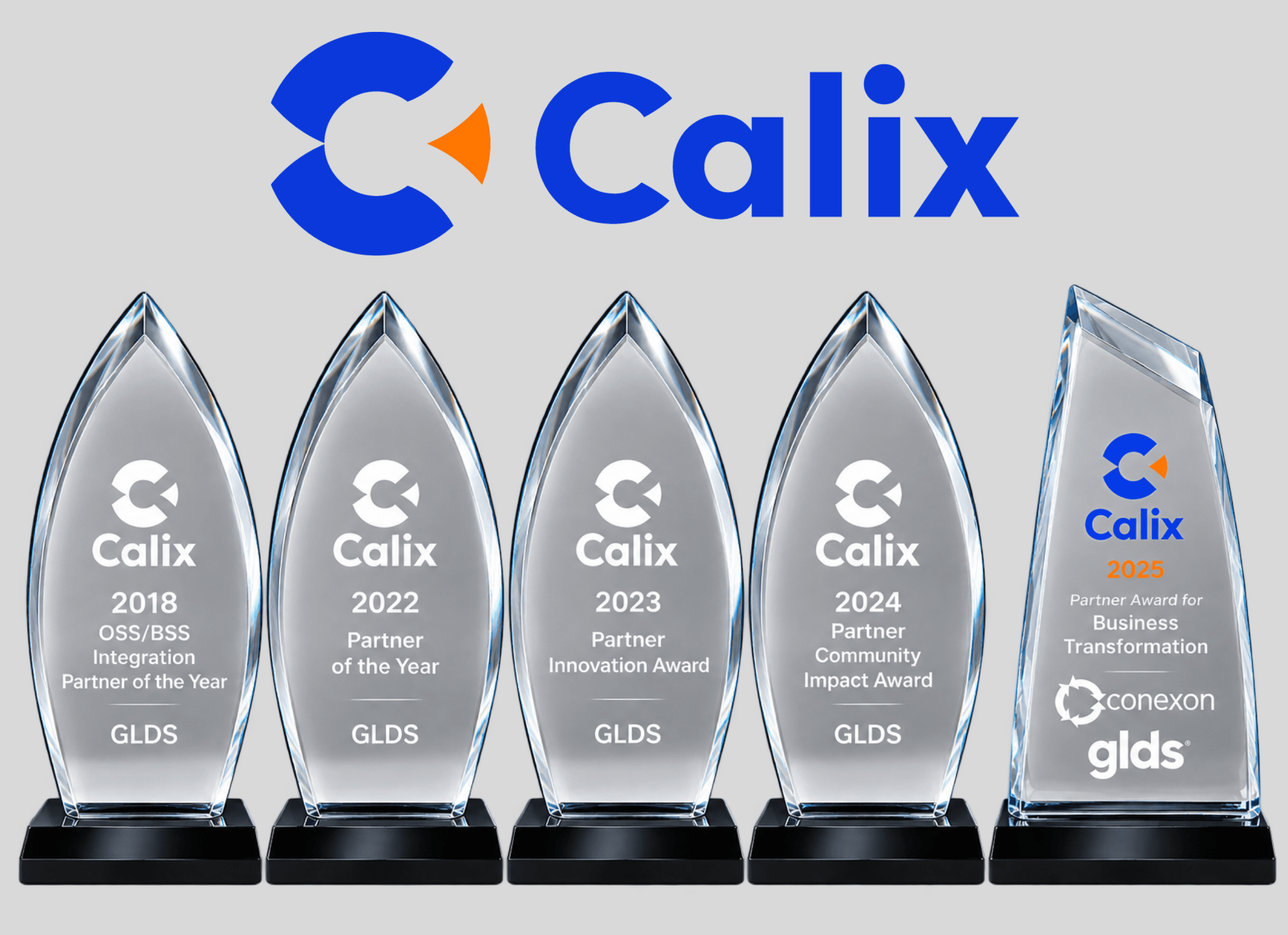
Conexon’s transformation initiative is that proof. More than 100,000 subscribers moved into a fully integrated GLDS and Calix ecosystem, with real-time synchronization across operational systems:
- 100K+ subscribers migrated
- Zero service disruption
- Under one hour of call-center downtime per migration
- 25%+ improvement in data fidelity
Data fidelity is the Sync Gap, measured. When billing and the network agree, everything Calix does gets easier to use: campaigns, support, diagnostics, and managed services.
Questions to Ask Your BSS/OSS Vendor
If you run Calix, these questions show how much of the platform your back office actually supports:
- Is your Calix integration API-based and real time, or file-based?
- When was it last extended, and what was added?
- Does it support Engagement, Service, and Operations Cloud, whether licensed together or separately?
- Do Service Cloud managed services turn on and off with the package, or by hand?
- Can managed services be sold both bundled and à la carte?
- Does SMx provisioning happen automatically through SuperController?
- Are legacy GigaCenter units handled the same as current GigaSpire systems?
- Are third-party devices fed to Calix Cloud?
- Has the integration been proven in a large migration, and what was the downtime?
Get Everything You Bought
Providers choose Calix because it does it all. Their BSS/OSS should let them use all of it.
That is the standard GLDS holds itself to. BroadHub is the system of record, and Calix follows: every cloud you license, every service you sell, every generation of equipment you run. The right service, every time.
Calix One does it all. GLDS does it all for Calix.
Ready to connect BroadHub to every Calix service you offer? Contact GLDS at sales@glds.com or 800.882.7950.
Calix, Calix One, GigaSpire, GigaCenter, and related Calix product names are trademarks of Calix, Inc. Supported capabilities may vary by deployment, Calix licensing, and platform version.
Download the Calix Integration Fact Sheet
The fact sheet will be emailed to the email address you provide.