You’re in the broadband business. Not the software integration business.
Starting or growing an Internet Service Provider is complicated enough. There’s a network to build, subscribers to acquire, services to deliver, and customers to keep happy. Every dollar and every hour matters.
So why would an ISP want to become a software developer or systems integrator, too?
Yet that’s exactly what happens when broadband providers attempt to assemble their own operating environment from a collection of disconnected software products.
One vendor handles billing. Another manages provisioning. Someone else provides scheduling, field service management, online ordering, payment processing, or customer self-care. Before long, the ISP has accumulated a collection of applications that weren’t necessarily designed to work together.
And somebody has to make them work together.
For most small and mid-sized broadband providers, that’s a distraction they can neither afford nor justify.
The Software You Don’t Know You Need
For a greenfield ISP, one of the biggest challenges isn’t choosing between competing software products. It’s knowing which products will be needed in the first place.
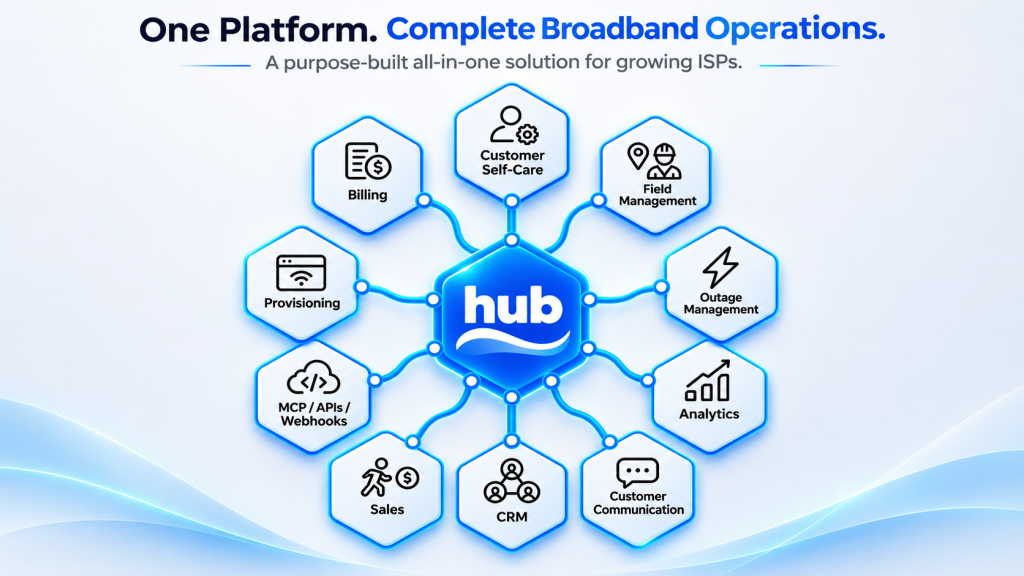
Billing and customer management are obvious. But what about:
- Service qualification and address management
- Product packaging, promotional pricing, and discounts
- Online customer acquisition and order entry
- Installation scheduling, dispatch, and field management
- Equipment inventory and tracking
- Automated network provisioning and service activation
- Payment processing, collections, and tax management
- Subscriber self-care and account management
- Automated customer communications and AI-powered support
- Reporting, analytics, and subscriber retention
And that’s hardly an exhaustive list.
An experienced broadband operator understands how these functions interact. A new ISP may not discover some of these requirements until thousands of subscribers are depending on its systems.
Even experienced operators can underestimate the complexity of connecting them.
That’s why choosing the right broadband billing software involves far more than evaluating billing capabilities. Operators need to consider the complete range of business and operational functions required to support the subscriber lifecycle.
The real value of a purpose-built broadband management system isn’t simply what it does. It’s everything the operator doesn’t have to figure out, build, or integrate independently.
The Hidden Cost of the DIY Approach
On paper, selecting individual software products can appear attractive. Choose the best billing application, the best scheduling tool, the best CRM, and the best provisioning solution.
But buying individual applications is only the beginning.
Someone must connect them, synchronize customer information, develop workflows, manage interfaces, test upgrades, troubleshoot failures, and maintain compatibility as each vendor changes its product.
That work doesn’t disappear after implementation. It becomes an ongoing operational responsibility.
And when something breaks, who’s responsible?
The billing vendor says its system sent the correct information. The provisioning vendor says it never received it. The integration developer says both applications are functioning properly.
Meanwhile, a subscriber is waiting for service, a technician is standing in the field, and the ISP is left sorting out whose problem it is.
Nobody started a broadband company because they wanted to referee disagreements between software vendors.
The true cost of a DIY software environment includes far more than licensing fees. It includes integration development, outside consultants, internal technical resources, ongoing maintenance, troubleshooting, and the business consequences of systems that don’t communicate reliably.
For a growing ISP, those costs can quickly outweigh any perceived advantage of assembling the system piece by piece.
One Integrated Platform. One Operational Environment.
An all-in-one broadband management system approaches the problem differently.
Rather than asking an ISP to assemble the capabilities required to operate its business, a purpose-built platform brings those capabilities together within an integrated environment.
Consider what happens when a new subscriber signs up.
The customer selects a service package and promotional offer. An installation is scheduled. Equipment is assigned. A technician completes the work. The service is provisioned on the network. Billing begins. The subscriber can then manage the account, make payments, change services, and request assistance online.
These aren’t separate business activities. They’re connected steps in a single subscriber lifecycle.
When the underlying software is designed to support that entire lifecycle, information can flow between departments and applications without requiring employees to reenter data or manage unnecessary handoffs.
This is the advantage of broadband BSS/OSS software built specifically for fiber and broadband operations. Billing, provisioning, customer management, and field operations are designed to work together rather than being connected through a collection of custom integrations.
The result is a more efficient operation, fewer opportunities for error, and a better customer experience.
All-in-One Doesn’t Mean Giving Up Flexibility
There’s an important distinction between an integrated broadband management platform and a collection of unrelated software applications.
An all-in-one solution doesn’t have to mean every component comes from a single codebase or that an ISP is locked into one technology supplier.
Broadband providers still need to work with network equipment manufacturers, payment processors, telecommunications platforms, tax services, and other specialized technologies.
The difference is whether those relationships are supported through proven integrations or left to the ISP to develop and maintain.
A mature broadband BSS/OSS platform should offer the best of both approaches: comprehensive native functionality for everyday operations and established integrations for the technologies that extend its capabilities.
The goal isn’t to eliminate choice. It’s to eliminate unnecessary complexity.
Purpose-Built for Broadband. That’s the GLDS Difference.
For more than four decades, GLDS has focused on developing software specifically for broadband service providers.
Our BroadHub® platform brings together the subscriber management, billing, CRM, product management, and operational capabilities that ISPs depend on every day.
Together with GLDS’ integrated solutions for network provisioning, field management, scheduling, online sales, customer self-care, and AI-powered customer engagement, BroadHub provides the foundation for managing the complete subscriber lifecycle.
GLDS also maintains an extensive ecosystem of established integrations with leading broadband technologies, including Calix, Adtran, Nokia, and many others.
These capabilities weren’t assembled to make a product demonstration look impressive. They’ve been developed and refined through real broadband operations and more than 875 deployments worldwide.
And because broadband is our business, our customers benefit from the experience gained by supporting hundreds of operators facing many of the same challenges.
A new ISP shouldn’t have to learn every lesson the hard way.
Focus on Building Your Business. Not Your Software.
There’s nothing wrong with building a custom software environment if developing and integrating software is a core competency of your organization.
But for most small and mid-sized ISPs, it isn’t.
Their expertise belongs in network construction, service delivery, subscriber acquisition, customer experience, and growing a profitable business.
Every dollar devoted to unnecessary software development is a dollar unavailable for network expansion, marketing, or customer service. Every hour spent troubleshooting integrations is an hour that could have been spent improving the business.
The right broadband management platform should help an ISP launch faster, operate more efficiently, and scale without continually adding software complexity.
It should provide the tools operators already know they need, along with the ones they haven’t thought of yet.
And when support is needed, it should be clear who is responsible for the core platform and its integrations.
You don’t need to build a software company to run a successful broadband company.
Let GLDS Handle the Software. You Handle the Broadband.
GLDS delivers a comprehensive, purpose-built broadband BSS/OSS environment designed to help ISPs operate efficiently, serve subscribers effectively, and grow with confidence.
Less custom integration work. Less reinventing the wheel. Less time managing software complexity you never intended to take on.
Just proven broadband management software that’s Real & Ready.